Published in Market Analysis
EU Meat Prices Cool From Winter Highs: How the Market Moved Through Mid-2026
EU beef, pork and lamb prices eased from their winter peak through July 2026 but stayed above historical norms. A month-by-month review of the first half, plus an assumption-based outlook on how drought-driven feed costs and animal disease could shape the rest of the year.

Martina Osmak
Director of Marketing
Meat prices across the European Union entered 2026 at the elevated levels they reached at the end of 2025, held near those highs through the winter, and then cooled steadily as the year moved into summer. This report tracks how official EU prices moved month by month from January to July 2026, category by category, using European Commission carcass price data. All prices are shown in euro per kilogram of carcass weight unless stated otherwise. The headline for the first half of the year is not a crash and not a fresh surge. It is a controlled easing from a high base: beef came off its winter peak in every category, pork ran a familiar spring rally before settling back, and lamb climbed into Easter and then reset lower into midsummer. Prices are lower than they were in February, but they remain well above where the market sat a year or two ago.
Key takeaways at a glance
Beef softened across the board. Every beef category peaked in late winter (January or February) and declined every month afterwards. Male bovines fell from 7.22 in February to 6.35 by July, a drop of around 12 percent, yet still sit at historically firm levels.
Pork ran a spring rally, then eased. Carcass classes climbed from a February low into an April peak, helped by seasonal restocking and grilling-season demand, before drifting back toward their starting point by July.
Lamb followed the calendar. Both light and heavy lamb rose into the Easter period in April, then reset lower through May, June and July, exactly the seasonal pattern the market expected.
The price map barely moved. Sweden stayed the most expensive beef market in the Union, Malta the dearest pork, and Croatia the highest-priced lamb market, month after month. The Baltics, Hungary and Greece remained at the low end.
The base is still high. The direction of travel in the first half was gently downward, but from a peak that was elevated by the supply constraints carried over from 2025. This is a cooling market, not a cheap one.

Beef: a steady descent from the winter peak

Beef was the clearest story of the first half. After the tight supply and firm prices carried over from 2025, the market topped out in January and February and then gave ground in almost every category, every single month.
Male bovines opened the year at 7.18, edged up to 7.22 in February, and then declined without interruption to 6.35 in July, a fall of roughly 12 percent from the peak. Young bulls told the same story more sharply, slipping from a February high of 7.37 to 6.38 by July, down more than 13 percent. Young bovines eased from 7.29 to 6.56, and heifers, the most resilient of the group, held better and only came off from 7.36 to 6.78. Cows, the entry point for manufacturing and processing beef, peaked slightly later in March at 6.20 before sliding to 5.65 in July.
The one category that broke the pattern was steers. Prices fell from 7.21 in January to a June low of 6.55, and then rebounded to 6.72 in July, the only beef line to finish the period rising rather than falling. Steers are a smaller, more specialised trade concentrated in a handful of countries, so their price is more sensitive to local supply than the broad bovine categories.
The geography of beef stayed remarkably stable. Sweden was the most expensive beef market in the Union across every category and every month, finishing July between 7.80 for cows and 8.39 for steers. At the other end, Lithuania anchored the low for male bovines and young bulls at 5.33, Hungary was cheapest for heifers at 4.78, Greece for cows at 3.32, and Latvia for young bovines at 5.52. Croatia sat comfortably in the middle of the range, with male bovines at 6.62 in July. The takeaway for buyers is that the spread between the cheapest and dearest origins remained very wide, often two to three euro per kilogram, so origin selection continued to matter as much as the direction of the average.
Pigmeat: a textbook spring rally that faded into summer

Pork moved on a different rhythm. Rather than declining through the half, the carcass classes traced the classic shape of the pig year: a soft winter, a strong spring, and a gentle summer fade.
Class S, the leanest grade, started the year at 1.49, dipped to a February low of 1.48, then rallied hard to peak at 1.70 in April, a rise of around 15 percent in two months. It then eased back to 1.59 by July. Class E followed the same curve almost exactly, running from 1.51 up to an April peak of 1.68 and back down to 1.51 in July, finishing the half essentially where it began. That round trip is the important point: the spring strength was real, driven by restocking and the build-up to the outdoor cooking season, but it was seasonal rather than structural, and it unwound as summer arrived.
Class R is quoted by a narrower group of reporting countries, so its EU figure is choppier and should be read with more caution. It moved between 1.83 and 1.96 without a clear trend, closing July at 1.95.
Piglet prices, which are quoted per head rather than per carcass kilogram, showed the sharpest seasonal swing of all. They climbed from 43 in January to a spring restocking peak of 63 in April, then fell away steeply to 41 by July as farmers finished placing animals for the summer. The rise and fall in piglet prices is an early signal, because today's piglet is next season's finished pig, and the sharp midyear drop points to caution among producers about the cost of feeding animals through to slaughter.
On the map, Malta remained the dearest pork market by a wide margin, finishing July at 2.42 for Class E and 2.47 for Class S, an island premium driven by import and logistics costs. The Netherlands sat at the efficient low end at 1.08 and 1.09. The gap between them, more than a euro per kilogram, is a reminder that the single pork market still trades at very different levels depending on where the animal is killed.
Sheep and goat meat: up into Easter, then the seasonal reset

Lamb behaved as lamb almost always does. The first half was shaped by the calendar, and specifically by the pull of Easter demand in early April.
Light lamb, the lighter carcass favoured in Mediterranean markets, opened at 9.95, softened slightly through February and March, then jumped to a clear peak of 10.51 in April as Easter buying tightened availability. From there it reset in an orderly way, easing to 10.05 in May, 9.61 in June and 9.42 in July. Heavy lamb ran the same course from a higher spring, climbing from 9.26 in February to an April peak of 10.31, holding near that level in May at 10.27, and then falling more steeply to 9.16 by July as the post-Easter supply built up.
The extremes here carry a local point of interest. Croatia was the single most expensive lamb market in the Union in July, at 12.22 for light lamb and 11.37 for heavy lamb, well above the EU average and a reflection of genuinely tight domestic supply and strong regional demand. At the low end, Latvia offered light lamb at 7.56 and Finland heavy lamb at 6.57. As with beef and pork, the spread across origins was enormous, close to five euro per kilogram between the cheapest and dearest light lamb, which keeps cross-border sourcing firmly in play for anyone with flexibility on origin.
Reading the first half as a whole
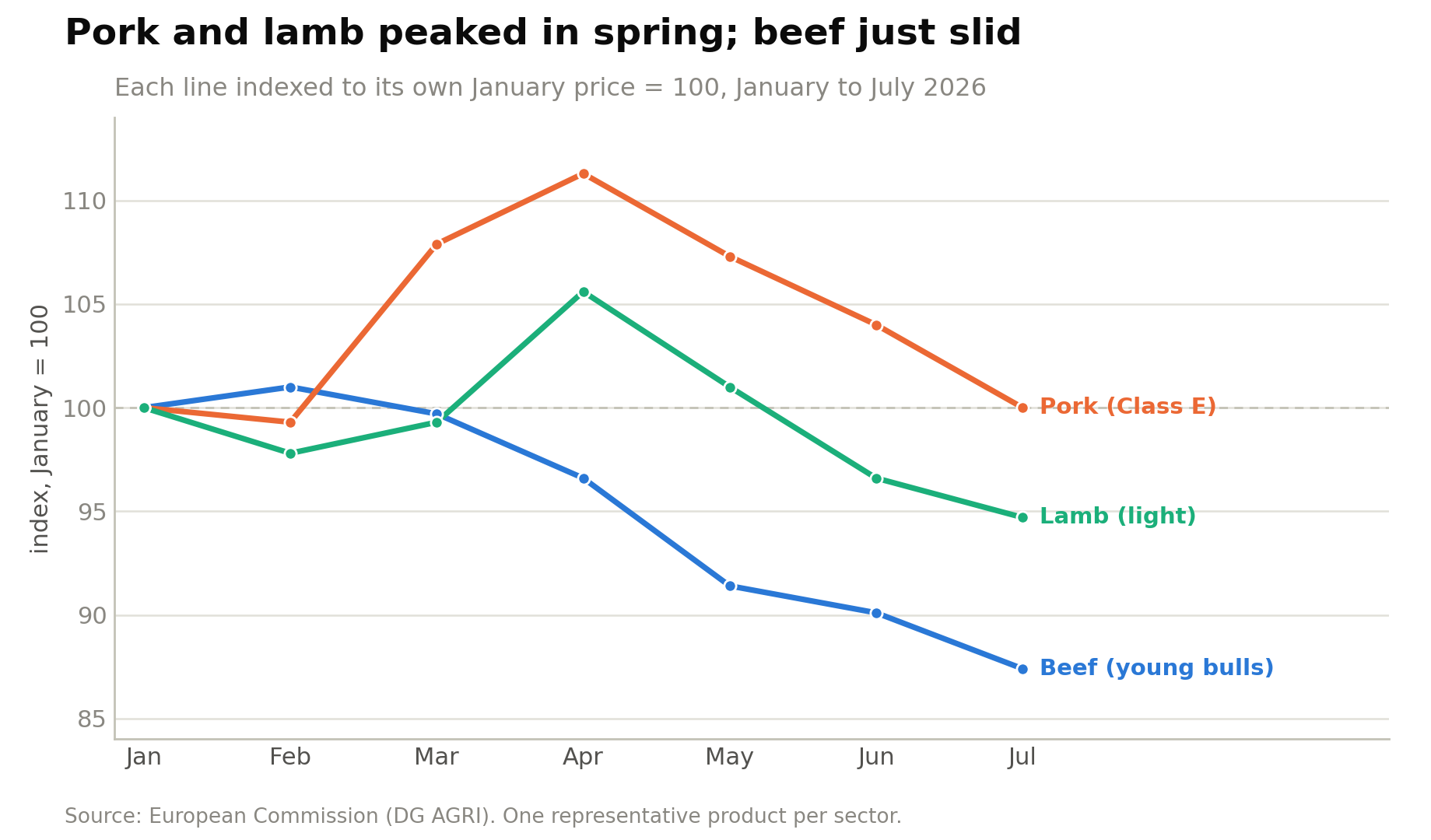
Put the three sectors side by side and a single pattern emerges. Everything peaked in late winter or spring and drifted lower into midsummer, but every category finished July above its longer-run norm. Beef cooled the most and most consistently. Pork made a round trip and ended roughly where it started. Lamb rose into Easter and reset afterwards. None of this was a reversal of the elevated market that 2025 handed to 2026. It was the release of the winter tension, softened further by the usual summer lull in fresh meat demand, sitting on top of a floor that supply constraints are still holding higher than usual.

Where the data ends and the outlook begins
Everything above this line is recorded market data through July 2026, taken from official European Commission price reporting. Everything below is our reading of where the market could go for the rest of the year. It is a set of assumptions and a scenario, not a forecast we can guarantee. We publish it because the forces now building are unusually visible, but the timing and the size of their effect are genuinely uncertain, and any of them could move faster or slower than we expect.
Three forces will shape the second half of 2026, and they do not all pull in the same direction.
1. Feed costs are the slow burn under everything
The most important development for the rest of the year is happening in the fields, not the abattoirs. A severe drought across France, Germany, Italy, Austria, Czechia, Slovakia, Hungary and Romania has cut expected EU summer crop yields to as much as 14 percent below the five-year average, with French corn production alone expected to fall by around half. At the same time, heavy rain has damaged the US corn and soybean crop, so the usual safety valve of cheap imports is less reliable than normal. The Union is expected to need more than seven million tonnes of extra maize imports in the 2026/27 season, and maize imports were already running about 41 percent higher than a year earlier by the end of August. Industry body FEFAC estimates the shortfall in home-grown forage will add more than one billion euro in extra soy-sourcing costs in 2027.
Feed is the single largest cost in producing pork and poultry and a major cost in finishing beef. Higher feed prices do not hit the meat counter overnight, but they raise the floor under production costs and they slowly work their way into the price of pork, beef and dairy over the following months. Our assumption is that this is an upward force on prices that strengthens through late 2026 and into 2027, and that it will be felt first and most directly in pork, the most feed-dependent of the sectors covered here.
2. Animal disease is tightening supply, region by region
The second force is animal health, and 2026 has been an eventful year. Bluetongue is spreading again, with the BTV-3 strain active in the United Kingdom and a more severe BTV-8 variant moving north across mainland Europe from southern France through Switzerland, Italy, Austria and southern Germany. Live ruminant exports from Great Britain to the EU have been blocked, and control zones are shifting within days. Bluetongue affects both sheep and cattle, so it acts as a supply drag on lamb and beef, most acutely in north-western Europe.
Further south and east, the picture is more serious for small ruminants. Foot-and-mouth disease crossed the EU border into Greece and Cyprus in 2026 for the first time in five years, which triggers immediate export bans wherever it appears. Sheep and goat pox, once confined to Turkey, exploded to roughly 2,000 outbreaks in 2025 and is now active across Greece, Bulgaria, Romania and North Macedonia. African swine fever remains a permanent background condition in Romania, Serbia and Croatia rather than a fresh emergency, but it continues to restrict where pork can be sold. Our assumption is that disease is a net upward force on lamb and beef prices through supply tightening and trade friction, concentrated in the south-east European corridor, and a source of extra cost and certificate checks for anyone trading small ruminants or pork across those borders.
3. Pork demand is the counterweight
Not everything points up. Pork faces a real demand problem on the export side. China, which took 43 percent of world pork imports in 2021, was down to 23 percent by 2025 as its domestic production recovered and its economy slowed. Global pork trade has shrunk from a peak above 12 million tonnes to under 10 million tonnes. New buyers such as Mexico and Southeast Asia are taking up some of the slack, but Brazil is competing hard for those customers, and European exporters face African swine fever restrictions on their export routes at the same time as Spanish production is rising. That combination points to domestic oversupply pressure on EU pork.
So pork is caught in a tug of war. Feed costs are pushing its cost floor up, while weak Chinese demand and rising internal supply are capping how far prices can rise. Our assumption is that pork stays range-bound to modestly firmer on cost pressure, rather than staging another sharp rally, and that it is the category most exposed to disappointment if export demand weakens further.
What this could mean by category
For beef, the summer softness may be close to its floor. Herds across the Union remain structurally tight, feed costs are rising, and bluetongue is a supply drag. Our assumption is that beef stabilises and then firms modestly through autumn on the usual seasonal pattern, with limited downside from July levels rather than a return to the winter peak.
For pork, we expect the spring rally not to repeat and prices to trade sideways to slightly higher, with the rising feed-cost floor doing more of the work than demand. The risk sits on the downside if China stays absent and Spanish supply keeps growing.
For lamb, the near-term seasonal reset could push prices a little lower into early autumn as supply builds, but the floor looks firm and the risk is to the upside. Tight global flocks, with Australian lamb slaughter down 13 percent in the first half, combine with bluetongue and sheep and goat pox in Europe to keep availability short. For a high-priced market such as Croatia, that mix argues for continued firmness rather than a deep correction.
The common thread across all three is that the input side, feed and disease, is pushing costs and constraining supply, while the demand side, especially for pork, is the main thing that could hold prices down. How the second half plays out depends largely on which of those two forces proves stronger, and that is exactly the balance we will be watching in the monthly data from August onward.
Conclusion
The first half of 2026 was a story of controlled cooling. Beef eased off its winter highs in every category, pork completed a seasonal round trip, and lamb rose into Easter before resetting, yet all three finished July above their historical norms. The direction was gently down, but the base stayed high. Looking ahead, the drought-driven rise in feed costs and a busy year for animal disease are building upward pressure on the cost of producing meat, while soft global pork demand is the main force pulling the other way. We will keep tracking the official numbers each month and update this view as the data comes in.
Sources
European Commission, Directorate-General for Agriculture and Rural Development, Monthly market prices (Beef, Pigmeat, Sheep and goat meat) - https://agridata.ec.europa.eu/extensions/DashboardPrice/DashboardMarketPrices.html
MeatBorsa blog, "Too Wet in America, Too Dry in Europe: A Riskier World for Feed and Meat." - https://meatborsa.com/en/blog/too-wet-in-america-too-dry-in-europe-a-riskier-world-for-feed-and-meat
MeatBorsa blog, "Bluetongue Spreads Again in Europe: A Warning for Sheep and Cattle Traders." - https://meatborsa.com/en/blog/bluetongue-spreads-again-in-europe-a-warning-for-sheep-and-cattle-traders
MeatBorsa blog, "What Seven Years of EU Animal Disease Data Mean for Meat Traders." - https://meatborsa.com/en/blog/what-seven-years-of-eu-animal-disease-data-mean-for-meat-traders
MeatBorsa blog, "Pork's New Buyers: How the Global Trade Map Is Being Redrawn." - https://meatborsa.com/en/blog/pork-s-new-buyers-how-the-global-trade-map-is-being-redrawn
MeatBorsa blog, "Lamb Prices Stay High on Tight Supply, but a Seasonal Reset Is Near." - https://meatborsa.com/en/blog/lamb-prices-stay-high-on-tight-supply-but-a-seasonal-reset-is-near