
Published in Industry Insights
What Seven Years of EU Animal Disease Data Mean for Meat Traders
Seven years of European Union animal disease reports show African swine fever holding steady, while a new group of diseases - foot-and-mouth, sheep and goat pox, and lumpy skin disease - pushes into the EU from the south-east. Here is what the shift means for anyone who buys or sells meat.

Martina Osmak
Director of Marketing
The picture is changing, and not where most people expect
Every year the European Commission publishes a report on animal disease outbreaks across Europe through its Animal Disease Information System, known as ADIS. On its own, a single year is just a long list of numbers. But when you line up seven years side by side - 2020 through to August 2026 - a clear story appears.
For anyone who buys, sells or sources meat, that story matters. Animal disease decides which countries and regions can trade, which shipments need extra paperwork, and where prices are likely to move. And the seven-year view holds a surprise: the biggest disease by far is not where the real change is happening.

Total animal disease outbreaks reported across Europe each year, 2020–2026. 2025 was the heaviest year on record. 2026 covers January to August only, so it cannot be compared directly with full years. Source: EU ADIS.
African swine fever: huge, but steady
African swine fever (ASF) dominates the numbers every single year. In wild boar alone it produces between roughly 6,000 and 12,000 recorded outbreaks a year across central and eastern Europe. That sounds alarming, but the important point is that it is not rising. The figure has moved up and down within the same band for seven years, with no clear upward trend.
Outbreaks on pig farms, which matter most for pork trade, are lower and come in waves. There was one severe year, 2023, when farms in the western Balkans - Bosnia and Herzegovina, Croatia, Serbia and Romania - were hit hard. Since then farm numbers have fallen back to a much lower level, even though they remain significant in Romania, Serbia and Croatia.
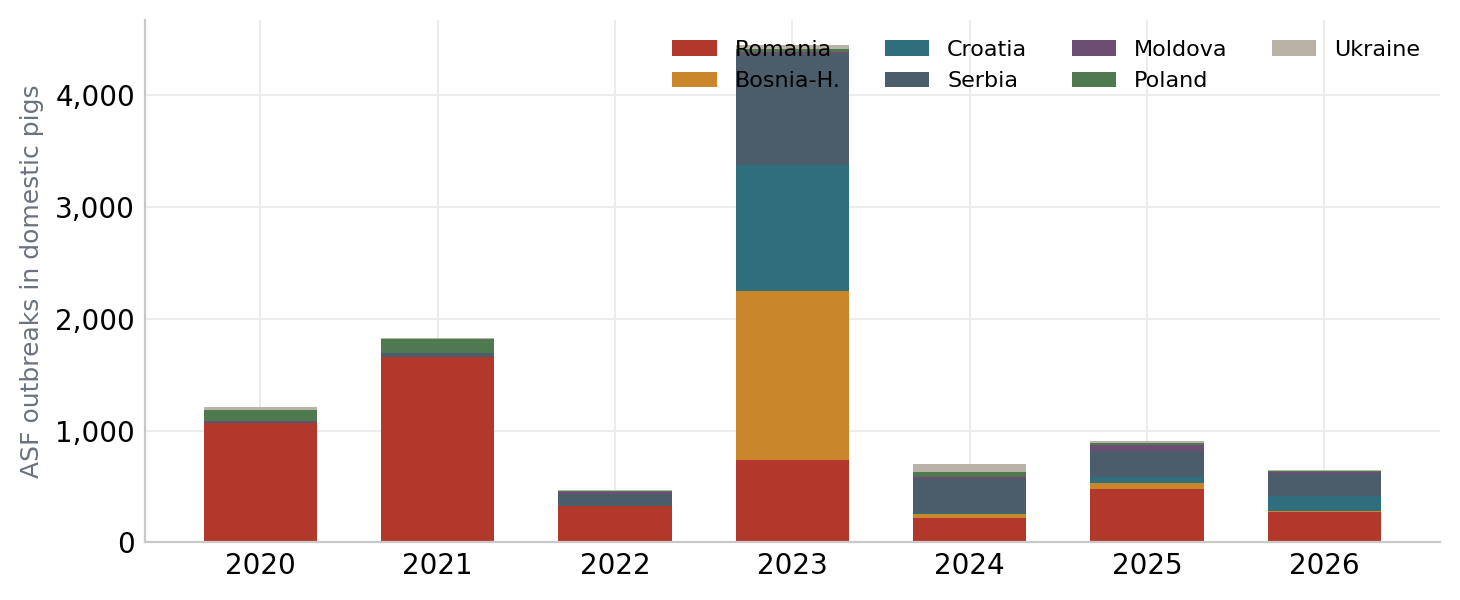
African swine fever outbreaks in domestic pigs, by country. The 2023 spike in the western Balkans stands out; current levels are far lower. Source: EU ADIS.
The takeaway: ASF is a permanent background condition, not a growing emergency. Europe manages it through regionalisation, which restricts specific zones rather than closing whole countries. It needs constant attention, but it is a known and managed risk.
The real shift: diseases crossing into the EU
The genuine change over seven years is happening with a group of diseases that used to sit outside the European Union, mostly in Türkiye. Between 2024 and 2025 they moved inward. This is where trade risk is actually growing.

Four diseases that were long confined mainly to Türkiye (grey) versus what reached the EU and the wider region (red), 2020–2026. The red bars from 2024 onward are the breakthrough. Source: EU ADIS.
Sheep and goat pox is the clearest example. For years it was almost entirely a Turkish problem. Then it broke into Greece in 2024, and in 2025 it exploded to around 2,000 outbreaks, centred on Greece and Bulgaria - roughly ten times any earlier year. In 2026 it is still active and has spread wider, reaching Greece, North Macedonia, Bulgaria and Romania.

Sheep and goat pox outbreaks by country. A Turkish-only disease until 2023, into Greece in 2024, and a Greek and Bulgarian explosion in 2025. Source: EU ADIS.
Foot-and-mouth disease (FMD) is the most serious of all. It is extremely contagious across cattle, pigs, sheep and goats, and it triggers immediate export bans wherever it appears. For five years FMD in these reports meant Türkiye and almost nowhere else. It built into a very large wave there in 2025 - and in 2026 it finally crossed the EU border, with outbreaks confirmed in Greece and Cyprus. This is the single most important development in the whole seven-year record.
Lumpy skin disease, a cattle disease, is the one piece of better news so far. It had been absent from Europe for three straight years, then appeared without warning in the western EU in 2025 - in France, Italy and Spain. In 2026 the numbers dropped sharply, which suggests it has, for now, been contained. But it proved it can reach the heart of Europe's cattle regions, so it stays on the watch list.
The common thread is simple: Europe's disease frontier in the south-east is more open than it used to be, and small-ruminant and cattle diseases are the ones moving through it.
Avian flu and insect-borne diseases: seasonal, but elevated
Two other groups round out the picture.
Avian influenza, or bird flu, remains the main disruptor for the poultry trade. It follows a clear seasonal cycle: farm outbreaks build through autumn and winter, peak in late winter and spring, then fall away in summer. Poland, Germany, France, Italy and the Netherlands carry the heaviest recurring burden. The quiet summer numbers are misleading - the risk rebuilds every year from around October.
Insect-borne diseases are also higher than they were. Bluetongue erupted in 2024 with a new strain that swept through north-west Europe, and West Nile fever has settled at a higher summer level since 2022. These mainly affect live-animal movements rather than meat directly, but they add to the checks and paperwork on cattle and sheep.

Bluetongue and West Nile fever outbreaks per year. Bluetongue's 2024 jump is the new BTV-3 strain in north-west Europe. 2026 is a partial, mid-season figure. Source: EU ADIS.
What this means for buyers and traders
Put together, the seven-year view suggests a shift in where to focus attention. Here is a simple read by product:
Pork: ASF is here to stay but is well managed through zoning. Keep origin and regional-status checks tight on pork from the western Balkans, where farm risk is highest.
Lamb, mutton and goat: this is the fastest-growing area of concern. Sheep and goat pox, foot-and-mouth and other small-ruminant diseases are all active across the Greece–Balkan–eastern-Mediterranean corridor. Verify current regional status and certificates for every consignment from this region.
Beef and cattle: watch western-EU origins for lumpy skin disease, and expect bluetongue to restrict live-cattle movement in north-west Europe each summer.
Poultry: plan for bird flu to return every autumn and winter, with Poland and Germany carrying the most recurring risk.
None of this changes the basic rule of cross-border meat trade: origin, regional status and documentation are what protect you. But the map of where problems are most likely has clearly moved toward south-east Europe and the small-ruminant sector. Traders who track official disease status and can prove the origin and standards of what they sell will be best placed as the situation keeps evolving.
One last note on the data. These figures count outbreak events, not the number of animals or the volume of trade, and the 2026 figures cover only part of the year. They are best used as a signal of where risk is building - a prompt to check official status before trading, not a substitute for it.
What comes next: our prediction
Everything above is a record of what has already happened. This final part is different. It is our best reading of where the next year or two may go, based on the seven-year trend. It is a prediction, not a certainty - weather, control measures and vaccination campaigns can all change the path. With that firmly in mind, here is what we expect.
The south-east stays the front line. Sheep and goat pox and foot-and-mouth are likely to remain the diseases to watch through 2026 and 2027. The very large foot-and-mouth reservoir now sitting in Türkiye means the pressure on the EU's south-eastern border will not ease quickly, and further incursions beyond Greece and Cyprus are a real possibility.
Small ruminants carry the most new risk. We expect lamb, mutton and goat sourcing from Greece, Bulgaria, Romania and the western Balkans to face the most frequent status changes and certificate checks.
African swine fever continues as usual. Expect another high year in wild boar, occasional farm flare-ups in the Balkans, and steady zoning - but no disappearance, and no single dramatic jump.
Bird flu returns this winter. The seasonal pattern is reliable. Plan for poultry disruption to rebuild from around October, with Poland and Germany most affected.
Insect-borne diseases keep spreading. Warmer, longer seasons point to bluetongue and West Nile fever reaching further north and lasting longer each summer.
The bigger picture for trade is simple. We expect disease status to change more often, and more locally, than it used to. In that environment the suppliers who can prove origin, health status and traceability quickly will hold a real advantage - and the buyers who follow official status closely will avoid the worst surprises.
We will revisit this prediction when the full 2026 figures are published, and see how it held up.
Sources
European Commission — Animal Disease Information System (ADIS), annual outbreak reports 2020–2026: https://food.ec.europa.eu/animals/animal-diseases/animal-disease-information-system-adis_en
and
https://webgate.ec.europa.eu/tracesnt/adis/public/notification
European Commission, Food Safety — foot-and-mouth disease: https://food.ec.europa.eu/animals/animal-diseases/diseases-and-control-measures/foot-and-mouth-disease_en
European Commission, Food Safety — lumpy skin disease: https://food.ec.europa.eu/animals/animal-diseases/diseases-and-control-measures/lsd_en
European Food Safety Authority (EFSA) — African swine fever: https://www.efsa.europa.eu/en/topics/topic/african-swine-fever
World Organisation for Animal Health (WOAH) — disease information: https://www.woah.org/en/disease/