Published in Market Analysis
EU Meat Prices Stay High in February 2026
EU meat prices remained elevated in February 2026, as the supply constraints that drove price increases in 2025 continued to influence beef, lamb, and pigmeat markets across Europe.

Martina Osmak
Director of Marketing
Introduction
This report examines meat prices across European Union countries in February 2026 and compares them with price developments observed during 2025 and January 2026. Prices are presented in euros per kilogram (€/kg), making them easier to interpret and compare internationally.
During 2025, meat prices increased unevenly across categories and countries. Beef and lamb markets experienced strong upward pressure due to declining livestock numbers and tighter supply, while pigmeat remained cheaper but more volatile. The January 2026 report showed that many of these trends continued into the new year.
The February 2026 data confirm that EU meat markets remain characterised by high prices and strong differences between countries, although price movements since January have generally been modest. In several categories, prices appear to be stabilising near the elevated levels reached during 2025 rather than continuing to rise sharply.
Summary: February 2026 in Context
Looking at the three reports together — the full-year analysis for 2025, the January 2026 report, and the February 2026 update — the main conclusion is that EU meat markets have entered a period of persistently high prices rather than temporary spikes.
The 2025 report showed that prices rose across most meat categories, particularly for beef and lamb, as lower animal numbers reduced supply. By the end of that year, several beef categories had already reached averages around €6–7/kg, while lamb prices in some countries exceeded €10/kg.
The January 2026 report confirmed that these high levels carried into the new year. Beef prices stabilised near the peaks reached in late 2025, lamb remained the most expensive meat category, and pigmeat continued to trade at much lower levels but with noticeable volatility.
The February 2026 data show that these patterns are largely unchanged. Beef prices remain strong, lamb prices are still very high despite small declines in some markets, and pigmeat prices remain comparatively low but uneven across countries. Poultry continues to be the most affordable animal protein.
Overall, the data suggest that the underlying factors identified in the 2025 report — including reduced livestock numbers, production costs, and structural differences between EU farming systems — continue to shape meat prices in early 2026.
Comparison Table
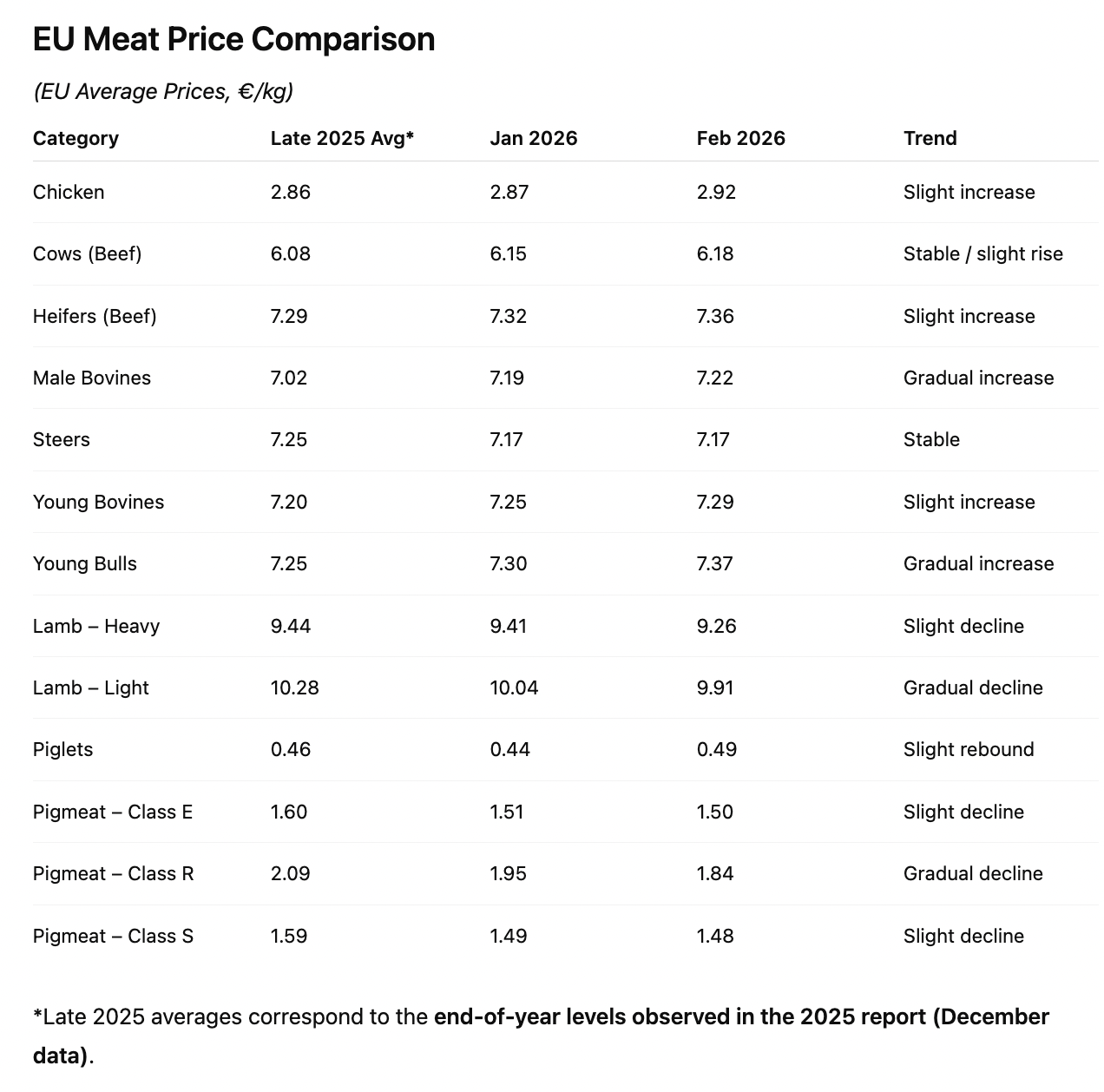
The comparison between late-2025 prices, January 2026, and February 2026 highlights several important developments in EU meat markets. Overall, prices across most categories remain close to the high levels reached at the end of 2025, indicating that the supply pressures seen last year have not yet eased.
Beef prices remain consistently strong. Most beef categories show either stability or slight increases between the three periods. Prices for cows, heifers, young bovines, and young bulls have edged upward since late 2025, while steer prices have remained largely unchanged. This confirms that the reduced availability of cattle for slaughter — a trend highlighted throughout 2025 — continues to support high beef prices across the EU.
Lamb prices remain the highest among all meat categories but show the first signs of modest easing compared with the peaks seen in late 2025. Both heavy and light lamb prices remain extremely high in several countries, but EU averages have declined slightly since the start of the year.
Pigmeat prices have gradually softened since the end of 2025. Across the main pig categories (Class E, R, and S), EU averages have declined slightly from the levels recorded during the previous year. Despite this, the pig sector continues to display significant price differences between countries.
Piglet prices have rebounded slightly compared with January. These markets often move quickly in response to producer expectations and herd expansion decisions, making them more volatile than finished pig prices.
Chicken prices have increased slightly but remain the lowest among major meat categories. This reinforces the longer-term trend in which consumers shift toward poultry when red meat prices rise.
Taken together, the comparison suggests that EU meat prices are stabilising at elevated levels rather than returning to the lower levels seen earlier in the decade.
EU Meat Prices – February 2026
Chicken
EU average: €2.92/kg
Lowest price: Bulgaria (€.94/kg)
Highest price: Germany (€4.60/kg)
Chicken prices varied widely across EU countries in February 2026. Bulgaria remained among the cheapest producers, while Germany recorded the highest prices. Despite the variation, poultry continues to be the most affordable animal protein in the EU, helping sustain strong consumer demand as beef and lamb prices remain high.
Beef
Cows
EU average: €6.18/kg
Lowest price: Bulgaria (€4.63/kg)
Highest price: Sweden (€7.46/kg)
Cow meat prices remained close to the levels reached at the end of 2025. Sweden again recorded one of the highest prices, while Bulgaria remained among the cheapest markets. The continued price gap between countries reflects differences in production costs, farming systems, and consumer purchasing power.
Heifers
EU average: €7.36/kg
Lowest price: Hungary (€4.54/kg)
Highest price: Italy (€7.97/kg)
Heifer prices remained among the strongest beef categories in February 2026. Italy again recorded the highest prices, while Hungary remained significantly below the EU average. High prices partly reflect farmers retaining more female cattle for breeding, which reduces the number available for slaughter.
Male Bovines
EU average: €7.22/kg
Lowest price: Slovakia (€5.83/kg)
Highest price: Sweden (€7.97/kg)
Male bovine prices remained close to the high levels seen at the end of 2025. Differences between countries were smaller than in some other beef categories, indicating that overall EU supply conditions remain the main factor driving prices.
Steers
EU average: €7.17/kg
Lowest price: Latvia (€5.86/kg)
Highest price: Sweden (€7.93/kg)
Steer prices remained stable in February, following the strong increases observed during 2025. Premium markets such as Sweden continued to record higher prices, while Baltic countries remained well below the EU average.
Young Bovines
EU average: €7.29/kg
Lowest price: Latvia (€4.77/kg)
Highest price: Italy (€7.93/kg)
Young bovine prices stayed close to the high levels reached in 2025. Italy recorded the highest prices, while Latvia remained among the lowest. The wide spread reflects structural differences in finishing systems and production efficiency across the EU.
Young Bulls
EU average: €7.37/kg
Lowest price: Slovakia (€5.83/kg)
Highest price: Sweden (€7.97/kg)
Young bull prices remained strong and broadly consistent across most countries. Compared with the sharp increases seen during 2025, prices appear to have stabilised rather than continuing to rise significantly.
Pigmeat
Piglets
EU average: €0.49/kg
Lowest price: Netherlands (€0.33/kg)
Highest price: Sweden (€1.09/kg)
Piglet prices continued to show large differences between countries. The Netherlands recorded some of the lowest prices due to large-scale production, while Sweden showed much higher prices linked to smaller domestic supply.
Pigmeat – Class E
EU average: €1.50/kg
Lowest price: Netherlands (€1.13/kg)
Highest price: Sweden (€2.65/kg)
Class E pigmeat prices remained relatively stable compared with January. The Netherlands continued to record some of the lowest prices in the EU, while Sweden remained among the highest.
Pigmeat – Class R
EU average: €1.84/kg
Lowest price: Czechia (€1.23/kg)
Highest price: Italy (€1.95/kg)
Class R prices showed a moderate spread between countries. Italy recorded the highest prices, reflecting strong demand for pork used in processed products.
Pigmeat – Class S
EU average: €1.48/kg
Lowest price: Netherlands (€1.14/kg)
Highest price: Sweden (€2.70/kg)
Class S pigmeat continued to show one of the largest price gaps between countries. Sweden recorded very high prices compared with most other markets, while the Netherlands remained among the cheapest producers.
Sheep and Goat Meat
Lamb – Heavy
EU average: €9.26/kg
Lowest price: Romania (€4.17/kg)
Highest price: Croatia (€13.56/kg)
Heavy lamb prices remained extremely high in February 2026. Croatia again recorded the highest prices, while Romania remained among the lowest. Limited sheep numbers and strong demand continue to support lamb prices across much of Europe.
Lamb – Light
EU average: €9.91/kg
Lowest price: Latvia (€6.79/kg)
Highest price: Hungary (€13.81/kg)
Light lamb prices remained very high but varied widely between countries. Hungary recorded the highest prices in February, while Latvia remained among the cheapest markets.
Conclusion
The February 2026 data confirm that the main trends identified in the 2025 and January 2026 reports remain in place. Beef and lamb prices continue to trade near historically high levels due to tight supply, while pigmeat remains cheaper but more volatile. Poultry continues to be the most affordable animal protein across the EU.
Large price differences between countries persist across all categories, reflecting structural differences in farming systems, production costs, and domestic demand. Overall, the data suggest that EU meat markets are currently stabilising at high price levels rather than returning to the lower levels seen earlier in the decade.
Source
European Commission – https://agridata.ec.europa.eu/extensions/DataPortal/prices.html
MeatBorsa: