Published in News
Control Over Volume: Inside the Meat Market
Explaining what happened this week in the meat industry and how it may impact trade, supply and prices.

Martina Osmak
Director of Marketing
Market Snapshot
For readers short on time:
• Pig slaughter in the Netherlands has fallen to a 15-year low after farm closures.
• Vion is selling major German plants, accelerating industry consolidation.
• New cases of ASF and Aujeszky’s disease highlight persistent animal health risks.
• The EU seed law debate shows growing regulatory control over inputs.
Market signal: the meat industry is shrinking in parts of Europe, becoming more regulated, and more concentrated.
So What?
For years, growth in the meat industry was simple.
More animals.
More production.
More trade.
That model is changing.
This week’s developments point in one direction:
The industry is no longer optimizing for volume. It is being forced to optimize for control.
Control over:
• environmental impact
• disease risk
• supply chains
• and increasingly, inputs
That shift changes how the market behaves.
Fewer Animals, Not a Cycle but a Policy Outcome
The drop in Dutch pig slaughter is not a market correction.
It is policy in action.
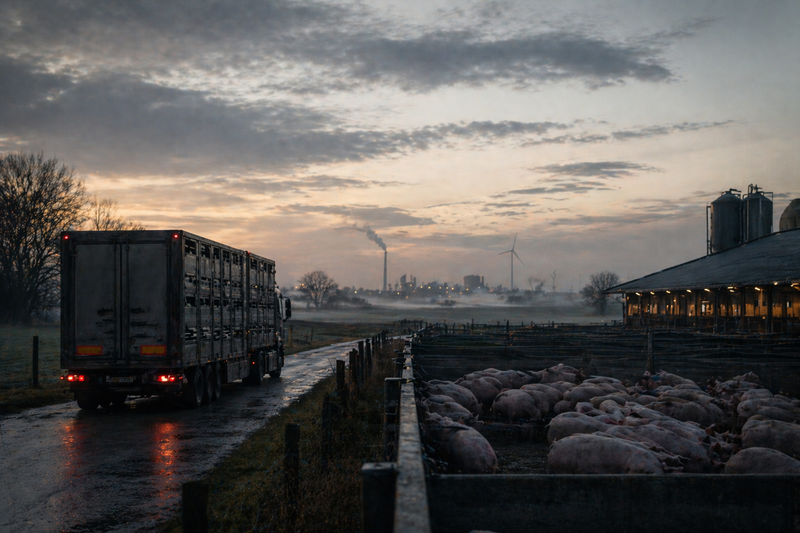
Government-backed buyouts have reduced the national herd to its lowest level in decades. Slaughter volumes are now down more than 17 percent compared to five years ago.
This is important because it breaks a common assumption in livestock markets.
Normally, supply falls because of price cycles.
Here, supply is falling because of deliberate structural reduction.
And once capacity is removed, it does not return quickly.
That creates a different type of market.
One where supply becomes permanently tighter, not temporarily reduced.
Processing Is Adjusting to a Smaller System
At the same time, the processing sector is adapting.
Vion’s decision to sell two major plants in Germany is not just a company story.
It reflects a broader shift.
The industry is moving toward:
• fewer facilities
• larger operators
• more specialized processing
This is what happens when supply shrinks.
Excess capacity disappears.
Ownership concentrates.
And the system becomes more efficient, but also more fragile.
Because fewer plants means fewer alternatives when something goes wrong.
Disease Risk Remains Constant
While supply shrinks and consolidation increases, disease risk has not gone away.
ASF has returned in Germany.
Aujeszky’s disease is reappearing in parts of Europe.
These are not headline-grabbing outbreaks.
But they do not need to be.
In livestock markets, the risk is not just the size of the outbreak.
It is the constant presence of the threat.
Because disease introduces uncertainty into a system that already has less flexibility.
And when flexibility is low, even small disruptions matter more.
Regulation Is Moving Upstream
One of the quieter but more important developments this week is the EU seed law proposal.
At first glance, it is about crop production.
But in reality, it is about control over inputs.
Seed regulation affects:
• crop yields
• feed availability
• production efficiency
And that flows directly into livestock production.
The direction is clear.
Regulation is no longer focused only on farms or processing.
It is moving upstream into the foundations of the food system.
The Real Market Shift
Put these pieces together, and the pattern becomes clear.
The meat industry in parts of Europe is not expanding.
It is:
• reducing herd size
• consolidating processing
• tightening regulation
• managing constant disease risk
This is not a short-term adjustment.
It is a structural shift.
The Real Question
The key question is no longer whether supply will tighten.
That is already happening.
The real question is:
How does a smaller, more controlled system behave under pressure?
Because smaller systems can be efficient.
But they also tend to be less resilient.
What the Market Should Watch
• Whether herd reductions in Europe continue beyond current policy programs.
• Further consolidation in processing, especially in Germany and the Netherlands.
• New disease cases and their impact on trade and farm operations.
• Final direction of EU seed regulation and its effect on feed production.
Because when control replaces expansion, the market does not just get smaller.
It starts to behave differently.
Sources: