Published in News
Seed Law Confusion in the EU
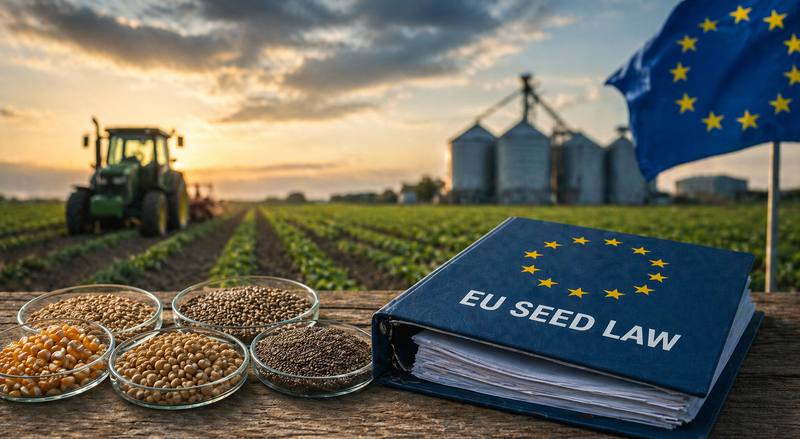
The European Union is updating its seed rules, and while the proposal is still under discussion, it is already drawing attention across the food supply chain.

Martina Osmak
Director of Marketing
What Is the EU Seed Law Proposal?
The European Commission introduced a proposal in July 2023 to update legislation on what is called “plant reproductive material.” This includes seeds, cuttings, and young plants used in agriculture.
The aim is to replace several older laws with one unified framework that applies across all EU Member States.
The proposal focuses on:
Updating outdated legislation
Creating consistent rules across the EU
Ensuring seed quality and traceability
Supporting agricultural adaptation to climate conditions
Why It Is Relevant Beyond Crop Farming
Although the proposal directly targets plant production, it has indirect relevance for other sectors, including livestock and meat production.
Animal feed relies on crops such as maize, soy, and cereals. Changes in seed regulation can influence:
The availability of crop varieties
Production efficiency
Long-term supply stability
For this reason, developments in seed policy may be of interest across the wider agricultural sector.
What the Proposal Regulates
The proposal mainly addresses how seeds are placed on the market.
Key elements include:
Requirements for registering plant varieties before sale
Rules on testing for quality and performance
Harmonized certification procedures across EU countries
These types of requirements are not new. They already exist in current legislation, and the proposal aims to update and simplify them.
What the Proposal Does Not Cover
Public discussion has sometimes extended beyond the actual scope of the proposal.
Based on the current draft, the regulation does not:
Prohibit individuals from growing plants for personal use
Ban the saving of seeds for private use
Directly regulate non-commercial gardening activities
The primary focus remains on commercial activities involving seeds.
Points of Discussion
The proposal has generated discussion among different stakeholders. These discussions focus on how the rules may be applied in practice.
Topics raised include:
Administrative requirements for smaller operators
The treatment of seed exchange activities
The role of traditional and local plant varieties
The balance between standardization and diversity
Different organizations and industry groups have expressed varying perspectives on these points.
Current Status
As of 2026, the proposal has not yet been adopted into law.
It is currently under negotiation between:
The European Commission
The European Parliament
Member States within the Council of the EU
Further revisions are possible before a final version is agreed.
Conclusion
The EU seed law proposal is a regulatory update focused on the marketing and quality control of plant reproductive material.
While it is primarily relevant for crop production, its indirect effects may be of interest to other parts of the agricultural sector, including livestock and meat production.
As the legislative process continues, stakeholders across the food chain are monitoring how the final rules will be defined.
Disclaimer
This article reflects our current understanding of the proposal based on publicly available information and may evolve as the legislative process continues.
Sources:
European Commission, “Future EU rules on plant and forest reproductive material”
https://food.ec.europa.eu/plants/plant-reproductive-material/legislation/future-eu-rules-plant-and-forest-reproductive-material_enEuropean Parliament, “Revision of legislation on seeds”
https://www.europarl.europa.eu/legislative-train/theme-a-european-green-deal/file-revision-of-legislation-on-seeds-plant-and-forest-reproductive-materialCivil society and sector responses
https://www.eurovia.org/news/open-letter-the-proposal-on-the-marketing-of-plant-reproductive-material-is-a-setback-for-already-recognised-farmers-rightsIndustry reporting on EU legislative process
https://www.mmjdaily.com/article/9808582/eu-seed-legislation-final-trilogue-take-place-in-brussels