Published in Market Analysis
Chokepoint 2026: The Second Gate — Houthi Gains in Yemen Put Bab el-Mandeb Back in Play
Ground control of the strait is not the same thing as attacking ships in it, however it piles on risk just as carriers were returning to Suez.

Bo Pedersen
Chief Revenue Officer
Market Snapshot
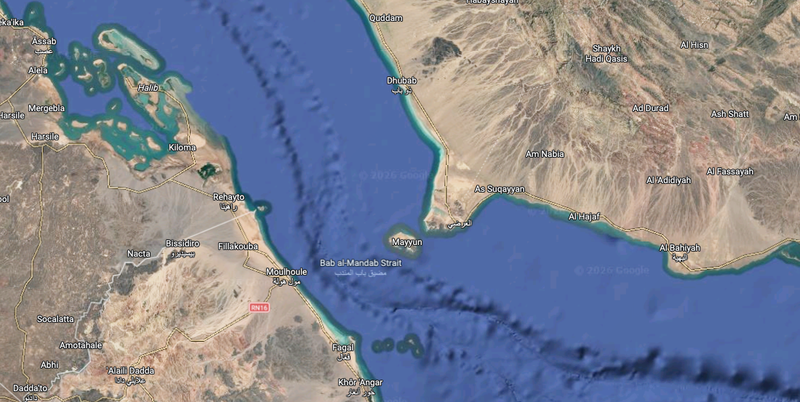
Houthi forces took the Red Sea port of Mokha on 10 September, having already pushed government forces out of Hays, Al Khawkhah and Dhubab. Yemeni government sources say Houthi fighters reached Perim (Mayyun) Island on 11 September after the Presidential Leadership Council (PLC) withdrew. Mokha sits roughly 50 miles from Bab el-Mandeb; Perim splits the strait's two shipping lanes.
Transits collapsed immediately. Kpler counted six vessels crossing Bab el-Mandeb on Thursday, against 30 on Wednesday and 26–29 earlier in the week. Five of the six were exiting the Red Sea.
Brent and WTI both moved back above $100 — the first time since mid-May.
Hormuz has been effectively shut to mainstream commercial traffic since late February. Saudi Arabia has leaned on the Red Sea and Yanbu ever since, which is why the Houthis' July embargo on Saudi shipping, and now their ground position, bite so hard.
The timing is brutal: MSC, Maersk and Hapag-Lloyd had only just begun partial returns to Suez, pulled back by 4.3m TEU of congestion in Asian ports. Drewry's WCI had Shanghai–Genoa down 10% week-on-week at $4,368/FEU on 3 September.
Market signal
The Red Sea risk has changed category. For three years it was an intermittent campaign of attacks that carriers could price, insure and wait out. Holding Mokha, Dhubab and the island in the middle of the strait converts that into standing territorial control — cheaper to sustain, harder to reverse, and impossible to insure against on the old assumptions. European meat prices do not reflect any of this yet.
So What?
Most of what has happened in this war so far was priced by Europe within a fortnight. Hormuz closed, urea went to $850/MT, feed budgets were rewritten, and by June the fertiliser panic had largely unwound — urea back near $453/MT — as buyers concluded the shock was temporary.
This is different, and the difference is not about severity. It is about permanence.
A missile campaign against shipping is an event or series of events. When it's over it's over. Ground control of both banks and the island at the centre of a 16-mile channel represents a structural shift, which is unlikely to be reversed anytime soon.
1. What actually changed, and what has not
Confirmed: the Houthis hold Mokha, Hays and Al Khawkhah, and government forces have withdrawn from Dhubab on the coast opposite Perim. Transit volumes through the strait fell roughly 80% in a single day.
Reported by government sources, not independently verified: that Houthi fighters have reached or taken Perim itself, and the Hanish islands. Reuters carries four Yemeni government sources on Perim; Euronews frames it as a completed takeover of the strait.
Not yet happened: a declared closure to all commercial traffic, or a resumption of indiscriminate attacks on container ships. The July embargo was aimed at Saudi-linked tonnage, and the two tankers struck on 23 July fit that pattern. Foreign ministers in the region are reportedly working on a temporary arrangement to manage shipping.
That last line matters. There is still a version of the next month where this settles into a permission-and-toll regime rather than a blockade — the same shape Iran has been running at Hormuz. For meat traders, a toll regime is not good news. It is simply a permanent cost line instead of a temporary one.
2. Cruel timing: Suez was reopening
This is the part the wider coverage is missing, and it is the part that decides freight costs into Q4.
Cape of Good Hope routing has been absorbing 5–7% of global container capacity — somewhere between 1.7m and 2.4m TEU of ships doing nothing but extra sea days. That absorption is the floor under freight rates. Over the last few weeks, congestion in Asian ports (4.3m TEU, worse than the pandemic peak) finally made the Cape detour more expensive than the Red Sea risk, and the three largest carriers started routing services back through Suez. Rates responded: Asia–North Europe and Asia–Med spot both came off, blank sailings were set to fall from four to one.
Every one of those decisions is now under review.
If the partial Suez return reverses, the capacity that was about to come back to the market disappears again, and it disappears into a Q4 peak season with Asian ports already gridlocked. That is the mechanism by which a firefight in Taiz province reaches a Rotterdam reefer quote.
3. Why this chokepoint hits meat harder than oil
Energy dominates the coverage because energy moves fastest. But protein is more exposed than crude on three counts.
Reefer capacity is a subset of a subset. Refrigerated slots are a small, inelastic share of the fleet. When general capacity tightens, reefer tightens disproportionately — and reefer boxes stuck on long-haul Cape rotations are boxes not repositioning to Santos, Montevideo or Fremantle.
Chilled has a clock on it. Vacuum-packed chilled primals tolerate a three-to-four-week voyage. They do not tolerate five to six. The Cape adds 10–20 days. Every rotation forced back around Africa converts a tranche of chilled trade into frozen trade, and that conversion is a permanent value loss of a euro or more per kilo depending on the cut, plus a labelling and compliance problem at the destination port.
Feed inflation gets a second wind. Up to a third of internationally traded fertiliser normally moves through Hormuz, and Gulf producers supply roughly a quarter of global urea exports. The April spike unwound on the expectation of reopening. If the Red Sea now closes off Saudi Arabia's western outlet as well, that expectation is wrong. Wheat is already up 24% and soybeans 8% since January. For poultry and swine operations, where feed is up to 70% of variable cost, a second fertiliser leg in Q4 lands directly on 2027 margins.
Implications
Near-shoring stops being a reaction and becomes a policy. European buyers who spent the spring improvising around the Southern Hemisphere gap now have the evidence to rewrite procurement permanently. Intra-EU corridors carry a structural premium for reliability that they did not carry in 2024.
A second chilled-to-frozen downgrade wave. Anything currently on the water toward the Gulf or routed through Suez is at risk of being frozen down mid-voyage. Expect distressed frozen premium product in the market within four to six weeks.
Reefer equipment shortages before the box shortage shows up in rates. Watch equipment availability, not spot indices. Rates lag; empty positioning does not.
Gulf-facing exporters face a third reroute in seven months. Brazil and Australia have already absorbed Hormuz and the airfreight collapse. Margin tolerance for a third round is thin.
Recommended Actions
Meat producers. Do not assume the June fertiliser retreat holds. If you unwound feed hedges over the summer on the view that Hormuz was reopening, that view is now materially weaker. Re-establish cover on corn and soymeal into Q1 2027 before the market reprices nitrogen.
Meat processors. Re-run energy and cold-store budgets at Brent above $100, not the $80s you have been working with since May. Audit reefer container commitments for Q4 now, while equipment is still available.
Meat traders. Two things to do this week. First, stress-test every open long-haul position for a Cape reroute — specifically, which contracts survive an extra 14 days and which become washouts. Second, get in front of the near-shoring demand: European buyers re-sourcing away from long-haul will move fast and pay for certainty.
What the Market Should Watch
Carrier announcements on Suez routing. MSC, Maersk and Hapag-Lloyd reversing their partial returns is the single cleanest signal that the capacity squeeze is back on.
Perim Island confirmation. Independent verification of control at the strait's narrowest point turns an interdiction risk into an interdiction capability.
War-risk premiums on Bab el-Mandeb transit. These sat around 0.5% of hull value in July against 0.1% for the northern Red Sea. Anything above 1% prices out marginal transits entirely.
The regional shipping arrangement reportedly under negotiation. A toll or permission regime is the most likely landing zone, and it sets a permanent cost floor.
Urea and nitrogen benchmarks. The leading indicator for 2027 feed. A break back above $600/MT confirms the second leg.
EU port arrivals of South American and Oceanian frozen. First hard evidence of redirected volume landing in Europe.
Chokepoint 2026 Series
The Exporter's Dilemma: Stranded Ships, Collapsing Air Bridges, and the Global Feed Shock
Australian Red Meat Exports Face Middle East Logistical Squeeze
Sources
MeatBorsa price benchmarks (VEZG, Vion, DCA, Mercolleida, Danish Crown, Bord Bia): https://meatborsa.com/en/prices
NPR, Iran-backed Houthi rebels seize strategic Red Sea port in Yemen, 11 September 2026: https://www.npr.org/2026/09/11/g-s1-142822/houthis-red-sea-port
Reuters via MarineLink, Houthi forces reach Perim Island, 11 September 2026: https://www.marinelink.com/news/houthi-forces-reach-perim-island-raising-542876
Euronews, Houthis seize Yemeni island in Bab el-Mandeb, 11 September 2026: https://www.euronews.com/2026/09/11/houthis-seize-yemeni-island-in-bab-el-mandeb-taking-control-of-the-strait
The National, Bab Al Mandeb and Hormuz ship transits plunge, 10 September 2026: https://www.thenationalnews.com/business/energy/2026/09/10/bab-al-mandeb-and-hormuz-ship-transits-plunge-as-war-intensifies/
Foreign Policy, Yemen's Houthis seize Mokha port near Bab el-Mandeb, 10 September 2026: https://foreignpolicy.com/2026/09/10/houthis-yemen-mokha-port-red-sea-bab-el-mandeb-iran-saudi-arabia-strait-hormuz/
Al Jazeera, Saudi-Houthi fighting in Yemen escalates, 8 September 2026: https://www.aljazeera.com/news/2026/9/8/saudi-houthi-fighting-in-yemen-escalates-what-happened-and-whats-next
The War Zone, Houthi stranglehold on Bab al-Mandab grows stronger: https://www.twz.com/news-features/houthis-stranglehold-on-strategic-bab-al-mandab-strait-grows-stronger
Al Jazeera, How shipping insurance rates are rising, 23 July 2026: https://www.aljazeera.com/economy/2026/7/23/how-shipping-insurance-rates-are-rising-as-hormuz-bab-al-mandeb-shut-down
Sogese / Drewry WCI via Logistics Update Africa, Asia-Europe rates fall as Suez capacity returns, September 2026: https://www.logupdateafrica.com/shipping/asia-europe-rates-fall-as-suez-capacity-returns-1360587
WTO Data Blog, Fertilizer trade impacted by Strait of Hormuz conflict, 10 July 2026: https://www.wto.org/english/blogs_e/data_blog_e/blog_dta_10jul26_451_e.htm
Council on Foreign Relations, Hunger warfare and a fertilizer crisis are straining global food supplies, September 2026: https://www.cfr.org/articles/hunger-warfare-and-a-fertilizer-crisis-are-straining-global-food-supplies
World Bank, Fertilizer prices surge as Strait of Hormuz disruptions tighten supplies: https://blogs.worldbank.org/en/opendata/fertilizer-prices-surge-as-strait-of-hormuz-disruptions-tighten-
U.S. Maritime Administration Advisory 2026-006: https://www.maritime.dot.gov/msci/2026-006-red-sea-bab-el-mandeb-strait-gulf-aden-arabian-sea-and-somali-basin-houthi-attacks