Published in Industry Insights
African Swine Fever: How Close Wild Boar Get to Pig Farms
New EFSA tracking data shows how often wild boar come close to European pig farms, while Saxony's 108 active African swine fever cases remain in wild boar only.

Martina Osmak
Director of Marketing
MeatBorsa's take
This section is our reading of the news, not reported fact. The confirmed figures are further down.
African swine fever in Central Europe is, for now, mostly a wild boar disease. Saxony in eastern Germany has 108 active cases, and not one is in a domestic pig herd. That is the good news. The new EFSA data is the reason we do not read it as a closed story.
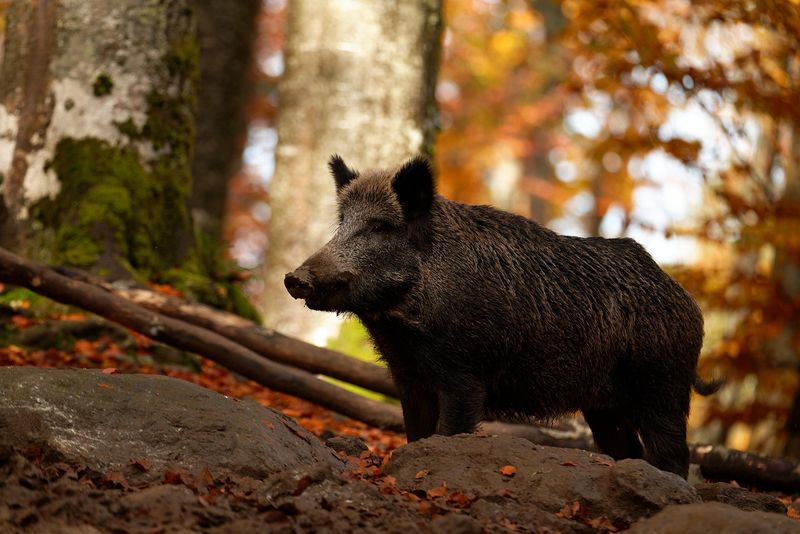
The EFSA tracking work shows that wild boar living near pig farms come within 50 metres of a farm in about one in five two-week periods. In other words, the distance between the virus and the pig supply is often a fence, a gate and a set of hygiene rules. So far that line is holding in Saxony. We think the market impact of ASF in Germany will keep coming mostly through restriction zones and through worry about a jump into farms, not through lost pig numbers.
The temperature finding matters for the next few months. EFSA links higher minimum temperatures to fewer positive carcasses and shorter persistence of the disease. Our inference is that the colder months are when infected carcasses stay a risk for longer, which is exactly the period the market is entering now.
What we assume, and why we could be wrong
- We assume farm biosecurity keeps holding. Saxony's domestic herds are unaffected even with 108 cases nearby. One farm outbreak would change the picture quickly, because it moves the issue from wild animals into the pork supply chain.
- We assume the cases stay in a tight area. In Saxony they are clustered around one range of hills, and negative tests around it suggest no spread so far. Higher boar density is linked to spread into new areas, so a dense local population is the main way this assumption could fail.
- We assume long-distance jumps stay rare. Most tracked boar stay within a small home range, but some travelled up to 60 km in two weeks. The separate outbreaks in western German states show that the virus can also appear far away for reasons that have nothing to do with boar walking there.
- We assume volumes are not the issue. As long as domestic herds stay free, German pig supply is not reduced by wild boar cases. If that changes, the effect on prices could be much larger than anything the wild boar cases have caused so far.
What the numbers actually say
On 16 November 2026, the European Food Safety Authority (EFSA) published a report on wild boar factors in ASF spread. It is based on GPS tracking of about 700 wild boar in ASF-free areas across 13 European countries, with data compiled by the EUROBOAR project.
Over a typical 14-day period, a wild boar used an average home range of 2.4 km². In rare cases, individual animals travelled up to 60 km in the same period. Among boar whose home range included pig farms, at least one approach to within 50 metres of a farm happened in 22% of the 14-day periods monitored.
Agriland's report on the same work, published on 21 November, adds that these approaches averaged four per 14-day period, and were more frequent among adult males and in landscapes that mix woodland and farmland. EFSA's message to farms in affected areas is to keep biosecurity tight.
EFSA also found:
- Higher wild boar density was linked to ASF spreading into areas that were free before.
- Where minimum temperatures were higher, a smaller share of wild boar carcasses tested positive and the disease tended to persist for a shorter time.
- Trained detection dogs make carcass searches more effective, and some Member States use drones, depending on the landscape.
In Germany, the Saxon State Ministry for Social Affairs, Health and Social Cohesion said on 16 November that the state has 108 active ASF cases. All of them are in a narrow area around the Königshainer Berge hills in the Görlitz district. Domestic pig herds in Saxony are not affected, and negative tests in the surrounding area suggest the infection has not spread beyond it.
Saxony had been declared free of ASF on 5 February 2026. A new case was found on 31 March, and the count has risen since then. The ministry also said that the outbreaks in Hesse, Rhineland-Palatinate, Baden-Württemberg and North Rhine-Westphalia are not linked to the Saxony or Brandenburg cases. They involve a different virus type from south-eastern Europe and were probably introduced by people.
What we are watching next
- Carcass finds in the Görlitz area over the winter, given EFSA's finding that the disease persists longer where temperatures are lower.
- Any case in a domestic herd in Germany, in Saxony or in the western states, since that is the step that would turn a wild boar story into a pork supply story.
- New finds outside the current Saxony cluster, which would test the assumption that the outbreak is contained.
A question some buyers may want to ask their suppliers: are any of the farms behind your lots located inside an ASF restriction zone, and what does that mean for where the product can be sold?
Sources
African swine fever: new insights from tracking wild boar movements - EFSA
Are wild boar spreading African swine fever to Europe's pig farms? - Agriland