Published in News
The First Days of the EU–Mercosur Deal
Between Expectations, Fear, and an Information Vacuum

Martina Osmak
Director of Marketing
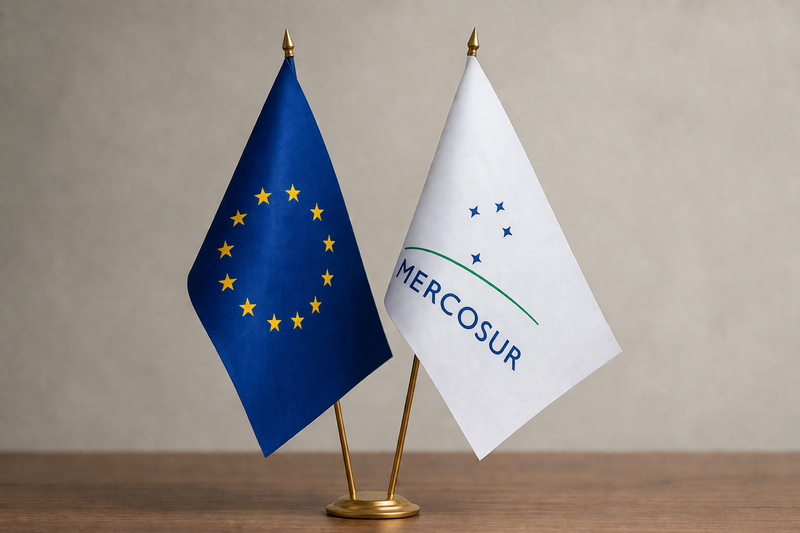
On May 1st, 2026, the long-debated EU–Mercosur trade agreement finally entered provisional force, creating one of the largest free-trade zones in the world. Covering roughly 700 million people and a combined economic weight rivaling the United States and China, the deal was immediately framed as historic.
Yet, in its first days, the agreement has revealed something unexpected: its most immediate impact is not economic - but political, psychological, and informational.
A historic agreement - on paper
European Commission confirmed that the agreement began provisional application at the end of April, with tariff reductions starting immediately. According to reporting from outlets like Associated Press, Al Jazeera, and Euronews, the deal eliminates tariffs on the vast majority of goods traded between the European Union and Mercosur countries (Brazil, Argentina, Uruguay, and Paraguay).
From a macroeconomic perspective, expectations are clear:
EU exporters gain access to South American markets for cars, machinery, and pharmaceuticals
Mercosur countries expand agricultural exports, especially beef and poultry
Businesses anticipate smoother trade flows and long-term growth
Policy and legal analyses - from outlets like Table Media and Advant Beiten - stress that implementation is phased and regulated, with quotas and compliance requirements limiting sudden disruption.
Even optimistic projections, however, are modest. The agreement is expected to produce gradual gains over years, not immediate shocks.
A backlash already underway
Despite its economic promise, the deal entered into force amid strong opposition.
Coverage from Le Monde and El País highlights deep divisions within Europe. Farmers, environmental groups, and some governments argue that the agreement risks:
undermining local agriculture
importing products produced under different regulatory standards
weakening environmental protections
This concern is especially visible at the regional level. A report from Cadena SER, focusing on Aragón, captures the tone of local reactions: farmers warn that imports could pose food safety risks and traceability challenges, even before significant trade flows have begun.
Consumer-focused organizations such as Euroconsumers echo similar concerns, emphasizing the difficulty of ensuring that imported goods consistently meet EU standards.
The reality: almost no measurable impact yet
Across all May 2026 reporting - from global outlets to regional press - one fact stands out:
There is no evidence yet of major changes in trade flows, prices, or supply chains.
The reasons are structural:
The agreement is only days old
Tariff reductions are gradual
Import quotas limit volumes
Regulatory compliance slows market entry
Even industry-oriented sources like MercoPress emphasize that the deal represents a long-term shift rather than an immediate transformation.
In short, the economic “aftermath” has not yet materialized.
Enter the viral narrative: the Greece salmonella claim
Against this backdrop of limited real-world impact, a striking claim began circulating on social media platform X (Twitter):
“80% of the first frozen chicken that arrived in Greece from Brazil were contaminated with salmonella.”
The claim quickly gained traction, tapping directly into the fears already present in public debate.
At first glance, it seemed to confirm the worst-case scenario: that lower-standard imports were already entering the EU market and failing safety checks.
What we actually found
Tracing the claim leads back to a single Greek outlet, which attributes the information to a press conference by a professional federation. According to that report:
A shipment of frozen chicken from Brazil was tested
A large portion allegedly tested positive for salmonella
The batch was reportedly rejected
However, when placed against the broader media landscape, the story becomes highly questionable.
No corroboration
None of the major outlets covering the Mercosur deal in May - including:
Associated Press
Al Jazeera
Euronews
Le Monde
El País
-report any contamination incident.
No pattern match
Regional reporting, such as the Cadena SER piece, discusses fears of food safety risks, but does not document actual cases.
No systemic signal
In the EU, significant food safety incidents-especially involving imports-are typically:
logged in regulatory systems
picked up quickly by multiple outlets
followed by official statements
None of this has occurred so far.
Why the story spread anyway
The Greece claim did not emerge in a vacuum. It fits perfectly into the broader narrative landscape:
1. Pre-existing fear
Farmers and consumers were already primed to worry about:
salmonella
hormones
pesticides
traceability
2. Timing
The claim appeared immediately after the deal entered into force, when:
attention was high
information was scarce
3. Information gap
Because there are no real-world outcomes yet, speculation fills the void.
A revealing contradiction
What makes this moment particularly interesting is the contrast between:
Verified reality (from May reporting)
The deal has just begun
Trade changes are minimal
No incidents are confirmed
Public perception
Imports are already flooding markets
Standards are already failing
Risks are already materializing
This gap between reality and perception is not accidental-it is the natural outcome of a highly politicized agreement entering a low-information phase.
The real “aftermath” of Mercosur - so far
Based on all available May 2026 reporting, the early aftermath of the EU–Mercosur deal can be summarized in three points:
1. Political conflict
The agreement has intensified divisions within Europe, particularly between:
agricultural sectors
trade policymakers
2. Trust deficit
Concerns about standards, enforcement, and transparency dominate public discourse.
3. Information instability
With no hard data yet, narratives - accurate or not - spread rapidly and shape perception.
Conclusion: a deal defined by uncertainty
In its first days, the EU–Mercosur agreement has not reshaped markets or triggered measurable economic shifts. Instead, it has exposed a deeper issue:
A lack of trust in how global trade is governed and enforced.
The viral Greece salmonella claim illustrates this perfectly. Whether true or not, it gained traction because it felt plausible within the existing narrative.
But based on all verified May 2026 reporting, the conclusion is clear:
There is no confirmed evidence of contaminated Mercosur imports entering the EU market so far.
For now, the story of Mercosur is not about trade flows - it is about how quickly fear can outpace facts when a major policy change meets an information vacuum.
Sources:
https://apnews.com/article/european-union-mercosur-trade-deal-571f8814c51667650cc7fa3e0a754b10
https://www.courthousenews.com/blockbuster-eu-mercosur-trade-deal-enters-into-force/
https://www.euroconsumers.org/eu-mercosur-consumer-empowerment/
https://elpais.com/economia/2026-05-01/1-de-mayo-dia-historico-para-uemercosur.html