Published in Market Analysis
EU Meat Prices: One Year in Review
Pork and piglets fell hardest, Swedish beef climbed against the tide and lamb was the only riser between September 2025 and September 2026.

Martina Osmak
Director of Marketing
Summary
Pork and piglet prices fell hard over the year to September 2026, beef cow prices slid across most of the EU, lamb got dearer and chicken barely moved. The EU average for top grade pig carcasses (Class E) dropped from €194 to €160 per 100 kg, a fall of 17.5%. Denmark lost 42.5%, the steepest drop anywhere in this data.
Piglets lost roughly a third of their value in the big producing countries. Beef went down too, with cows falling 10% to 24% in most markets. The one market moving against everything is Sweden: its beef prices rose 22% to 27% and now sit €150 to €250 above the rest of the EU.

Lamb is the only category that ended the year higher in most countries, led by Spain (+18%, light lamb) and Portugal (+20%, heavy lamb).
Key takeaways
Pork is in a deep slide. 22 of 24 reporting countries priced Class E pig carcasses lower than a year ago. Denmark (€115) and the Netherlands (€116) are now the cheapest in the EU, while Malta (€242) and Sweden (€222) stay on top.
Piglets point the same way. Denmark fell from €68 to €31, Latvia from €58 to €25, the Netherlands from €34 to €22. Today's cheap piglets are the slaughter pigs of early 2027.
Cow prices dropped across the continent. Austria -24%, Slovenia -23%, Italy -22%, Germany -19%, Czechia and the Netherlands -18%. Young bulls fell 9% to 16% in most markets.
Sweden is the big outlier. Every Swedish beef category is the most expensive in the EU: cows €745, heifers €793, young bulls €796, steers €783, all up 22% to 27% on the year. Finland moved the same way (cows +29%).
Lamb is the only riser. Spanish light lamb +18% to €1,112, Portuguese heavy lamb +20% to €962. Croatia is the dearest lamb market in the EU almost every month (light €1,294, heavy €1,266).
Chicken stands still. France reported €370 every single month, Germany €460 to €461. Poland is the exception, down 22% to €178, now 2.6 times cheaper than Germany.
Seasonal swings are huge in lamb. Romanian heavy lamb went from €417 in February to €917 in April, more than doubling into Easter.
Pork: a year of almost uninterrupted decline
The EU Class E average fell from €194 to €160 per 100 kg, and only France and Malta ended higher. Most of the damage was done by January, when the EU average hit €151; prices then hovered in a tight €151 to €162 band through the summer instead of recovering.

Class E pig carcasses.
Denmark is the story of the year. Its price slid month after month, from €200 to €115, without a single real rebound. Denmark was the cheapest Class E and Class S market in the EU in both August and September 2026.
France went the other way. After bottoming at €157 in February, the French price climbed to €202 by September (+29% in seven months), making France one of the few markets above its level of a year ago.
Romania had the wildest ride. It dropped to €122 in February, then recovered to €182 by September (+49%).
Class S and Class R tell the same story. The EU Class S average fell from €199 to €170 (-15%), with Denmark again at the bottom (€117, from €203). In Class R, Germany fell 22% (€175 to €136) and Czechia 18% (€167 to €137). Italy is the exception: its Class R price bounced from €191 in March to €242 in September, up 27% in six months.
Piglets: a third of the value gone
Piglet prices fell 28% to 57% in eight of the ten reporting countries, the sharpest drop of any product in this report. A short spring bounce (Belgium and Spain both touched €69 in April) faded completely by summer.

The Netherlands hit the lowest price in the whole dataset, €18 in July 2026. Sweden stays the most expensive piglet market at €92, four times the Dutch level. France again bucks the trend, rising from €43 to €57, in line with its rising carcass price.
Beef: most of Europe down, Sweden in a league of its own
Cows took the biggest hit in beef, with a median fall of 12.7%, while male cattle and heifers fell less. In every category Sweden was both the biggest riser and the most expensive market.

All prices €/100 kg carcass weight. Median change across countries reporting both Sep 2025 and Sep 2026.
The cow market fell almost everywhere. Besides Austria, big drops came in Slovenia (499 to 382, -23%), Italy (595 to 465, -22%), Germany (656 to 534, -19%), Czechia and the Netherlands (both -18%), Belgium, Lithuania and Latvia (all -17%). Only Sweden, Finland, Portugal (+7%) and Bulgaria (+4%) rose.
Young bulls slid steadily from their winter peaks. Spain went from €756 in December to €610 in September (-19% in nine months). Poland fell from €741 in November to €608. Germany dropped from €737 in December to €652. Against the trend, the Netherlands (+11%) and Romania (+14%) rose.
Sweden peaked in early summer. Swedish prices topped out in June (cows €805, heifers €852, young bulls €855, steers €867) and have eased a little since, but they still sit roughly €150 to €250 above most of the EU.
Italy leads on heifers. Italian heifers were the dearest in the EU from October to March, peaking at €817 in March, before Sweden overtook them. Italy now sits at €747.
Romania is the quiet climber. Romanian steers rose 16% (510 to 594) and young bovines 16% (665 to 772), against a falling market elsewhere.
Lamb: the one market that got dearer
Lamb prices rose in almost every country, and Croatia was the most expensive lamb market in the EU in nearly every month of the year. Croatian light lamb peaked at €1,383 in April and sits at €1,294; heavy lamb peaked at €1,363 in March and sits at €1,266.
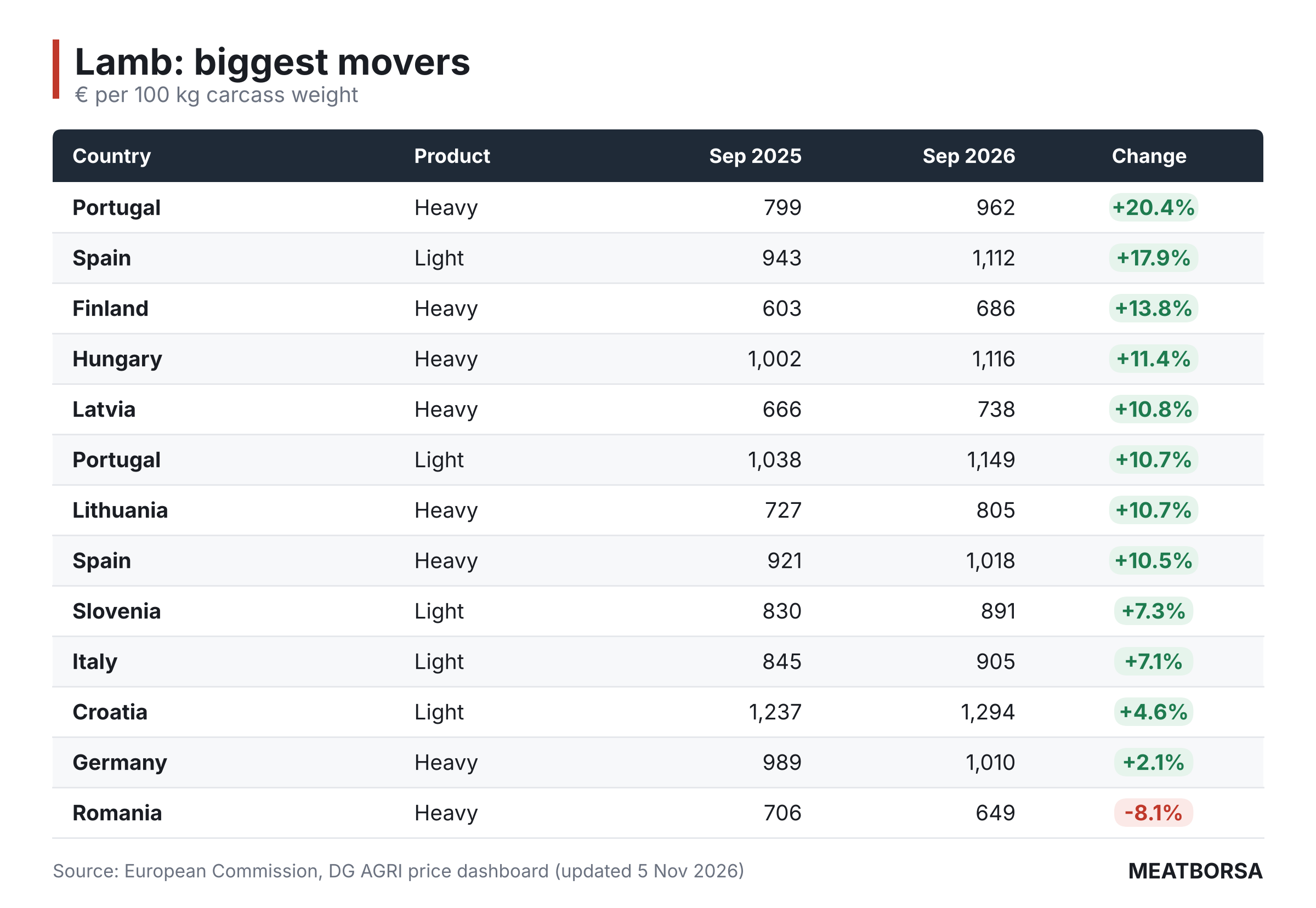
€/100 kg carcass weight. Biggest movers shown.
Holiday peaks drive this market. Easter pushed prices to their highest in March and April across most countries. Romanian heavy lamb more than doubled, from €417 in February to €917 in April. Portugal and Italy peaked at Christmas instead: Portuguese light lamb hit €1,281 in December, Italian light lamb €1,078.
Portugal was the most volatile. Its heavy lamb went from €1,011 in January down to €748 in July (-26%), then back up to €962 in September (+29%).
Ireland had a strong spring. Irish heavy lamb rose from €747 in February to €930 in June (+24%) before easing to €775.
Latvia (€646 light, €738 heavy) and Finland (€686 heavy) remain at the cheap end, roughly half the Croatian price.
Chicken: flat, with Poland as the exception
Chicken was the calmest market of the year: the median country moved less than 1%, and the EU average sat at €291 in September 2026. France reported exactly €370 in all 13 months, and Germany held at €460 to €461, the highest in the EU throughout.

€/100 kg carcass weight. Biggest movers shown.
Poland was the cheapest chicken market in the EU for most of the year and touched €168 in August. Austria climbed steadily, from €362 to €391, and is now second only to Germany.
Price gaps between countries
In September 2026 the most expensive EU market paid roughly double the cheapest for most products, and up to four times as much for piglets.

These are reported market prices, so part of each gap reflects differences in carcass spec, presentation and how each country reports, not only supply and demand.